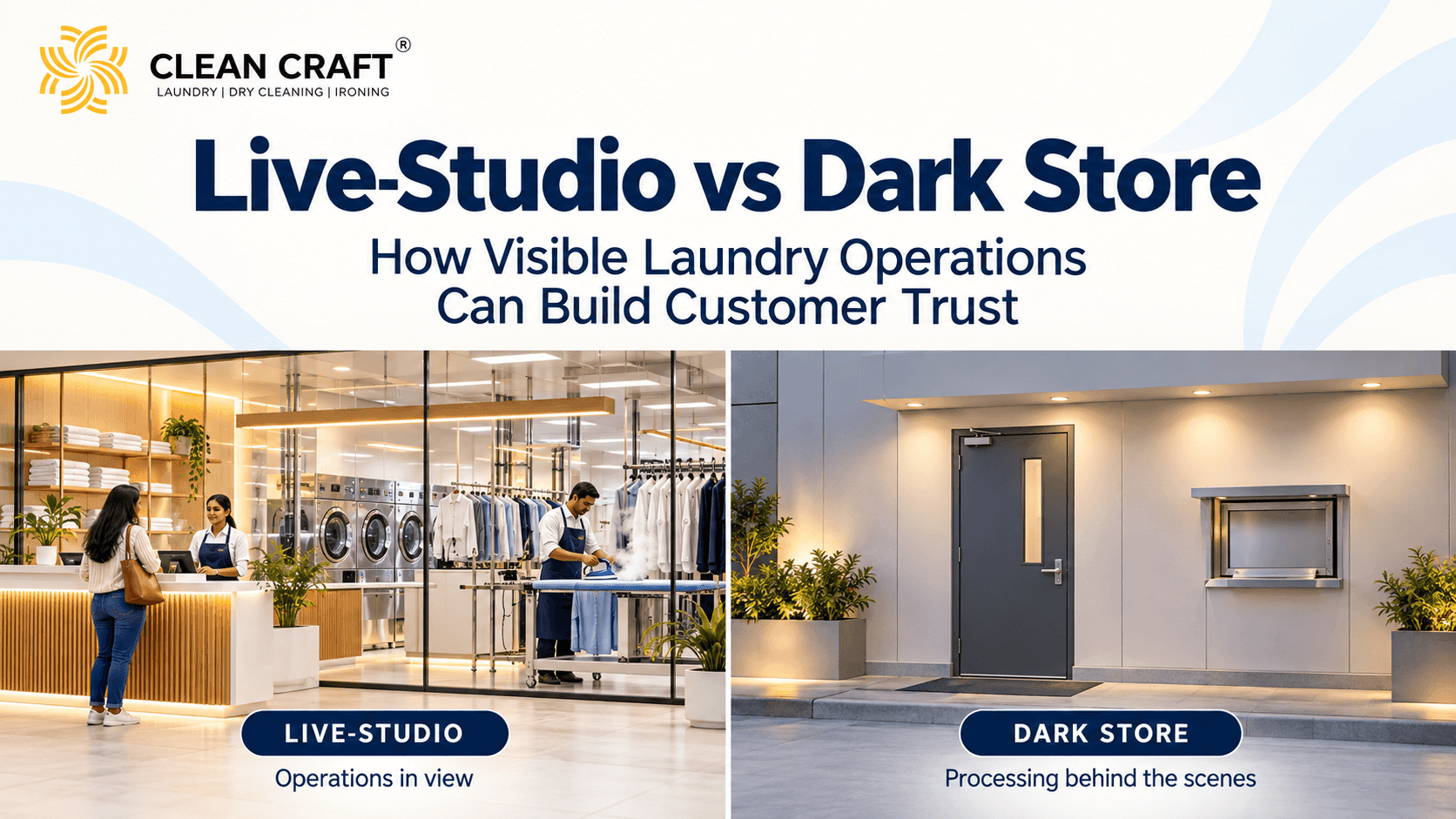
Live-Studio vs Dark Store: How Visible Laundry Operations Can Build Customer Trust
Starting a laundry business can be a profitable opportunity with the right laundry business plan and practical laundry business ideas. For entrepreneurs in India, a detailed laundry business plan in India PDF can help understand startup costs, operations, marketing strategies and the steps needed to build a successful laundry business with CleanCraft.
A live laundry studio combines a customer-facing shop with on-site processing. Its practical advantage is visibility: customers can visit, discuss their garments and observe the work, while also choosing app-based pickup and delivery.
A non-customer-facing laundry operation depends more heavily on digital updates, service records and remote communication to provide that reassurance.
For a franchise investor, the question is how the format supports customer confidence and daily operations. Clean Craft’s live-studio model brings together visible processing, individual QR garment tags, documented intake and neighbourhood delivery.
Here is how the models compare—and what visibility can realistically achieve.
What is the difference between a live studio and a dark-store laundry?
In this article, “dark-store laundry” means a processing location that customers do not normally visit. It is a working description, not a standard classification for every laundry business.
A central processing plant is a separate concept. It may receive garments from several collection shops or delivery routes. Those collection shops can still have customer counters and attract walk-ins.
| Customer or business consideration | Live studio with on-site processing | Non-customer-facing operation or central-plant model |
|---|---|---|
| Seeing the work | Customers can observe processing within the store's viewing arrangements | Customers generally rely on records, communication or an arranged visit |
| Discussing garments | A local counter provides a place for inspection and questions | Discussion may happen through a rider, support team or separate collection counter |
| Garment movement | In-store processing can avoid a separate shop-to-plant journey | A collection-shop model adds transfers to and from the processing plant |
| Tracking | Depends on identification, scanning and staff procedures | Also depends on identification, scanning and staff procedures |
| Walk-in opportunities | The processing studio can also serve as a retail storefront | A closed facility has no walk-in counter; separate collection shops may have one |
| Delivery orders | Can serve local customers through an app | Can also serve customers through an app |
| Main operating challenge | Managing retail service, processing and dispatch within one location | Coordinating processing, transport and customer communication across locations |
Neither layout guarantees good garment care. A visible studio still needs capable staff and reliable records. A central plant can also provide a well-controlled, traceable service.
Why visibility matters when handing over valued garments
Imagine a customer bringing an embroidered outfit for cleaning. Before leaving it, they may want to discuss a stain, point out a loose embellishment and understand when the garment will be ready.
A live studio gives that conversation a physical setting. Customers can see where the work happens and have a local place to return with questions.
That is a practical explanation of how visibility can support trust, rather than evidence that all Indian consumers distrust central plants.
The strongest reassurance combines three things:
• An accessible team: Someone can explain the proposed service.
• A clear intake record: The garment and its existing condition are documented.
• A traceable order: The customer receives updates tied to their booking.
A glass frontage alone cannot provide all three. The process behind the counter matters as much as the view.
How Clean Craft records garments at intake
Clean Craft confirms that garments are individually tagged with QR codes. At counter intake, the team records garment counts, photographs and existing damage.
These records give the customer and the store a reference point for what was handed over.
For example, a customer might submit five garments, one with a missing button and another with an existing stain. Recording the count and condition makes the handover more specific than a receipt that simply says “one bag.”
This example illustrates the process; it is not a customer case study.
A useful intake conversation also establishes the requested service, any concerns and the expected return date. Recording an existing issue does not establish whether it can be corrected during cleaning.
What QR tracking does—and what it does not do
Clean Craft scans garments at entry and exit, with automatic updates on the customer app.
Individual QR tags help connect physical garments with their records. Entry and exit scans document those particular checkpoints.
They should not be confused with continuous location monitoring or a scan at every cleaning stage. An entry scan confirms entry; an exit scan confirms exit. More detailed processing visibility would require additional recorded events.
Clean Craft’s customer website also describes app booking, order-status updates and pickups routed to a nearby live studio.
The useful question for a customer is straightforward: “What does this status tell me about my order?” Clear, accurately named updates are more helpful than a tracking screen whose meaning is uncertain.
Transit shrinkage: compare the handovers, not the promises
In this context, transit shrinkage means garments going missing during movement or handover, not fabric becoming smaller during cleaning.
Consider two illustrative routes:
Local live studio:
Customer → local studio → customer.
Collection shop with separate processing:
Customer → collection shop → processing plant → collection shop → customer.
Doorstep services add rider handovers to either route. Some centralised operators also collect directly for a plant, so the second route does not describe every business.
When processing happens at the receiving studio, it can remove the separate collection-shop-to-plant transfer. That means fewer transfer points to coordinate in that particular comparison.
It does not establish a lower garment-loss rate. Clean Craft has not supplied comparative loss data for this article.
Whatever the model, investors should inspect how garments are identified, counted and reconciled at handover—and how staff investigate a mismatch. Good records matter even when every stage happens under one roof.
One studio, two ways for customers to order
Clean Craft’s live studio combines a physical retail presence with app-based pickup and delivery.
Street-level walk-ins
A visible storefront gives people a place to discover the service, discuss a garment and place an order directly.
The potential customer journey is:
Notice the studio → ask a question → inspect the service → place an order.
That creates an opportunity for a sale. It does not prove that a particular proportion of visitors will convert.
The opportunity depends on the location, signage, accessibility, counter service and the customer’s needs. Passing footfall should not be treated as revenue.
Neighbourhood app orders
Customers who prefer doorstep service can book through the app. Clean Craft confirms support for store allocation, rider assignment, garment tracking, notifications and delivery confirmation. Automatic pickup and drop assignment can be enabled.
The physical studio can therefore process orders from customers who visit and customers who do not.
A customer might first discover the business by walking past, then use delivery for subsequent orders. Another might begin with an app booking and later visit the studio. These are possible customer journeys, not measured Clean Craft conversion results.
Why the combination matters to a franchise owner
The format offers two routes into the same local business: retail visits and digital bookings.
That can broaden how customers access the service, but both channels draw on the same processing capacity, staff and delivery resources. An increase in orders needs an operating plan as well as a marketing plan.
A useful store dashboard would distinguish walk-in enquiries, first orders, app orders and repeat purchases. It should also avoid counting the same customer twice when they switch channels.
Does a live studio guarantee faster delivery?
No. Processing location is only one factor in turnaround.
Workload, service type, inspection, cleaning requirements, finishing and delivery scheduling all affect the return date. Removing a transfer does not automatically make every order faster.
Clean Craft states a maximum standard turnaround of 4–5 days, with express service also available. Customers should confirm the specific return date at booking. Express timing, eligibility and any additional charge should be established before accepting the order.
For investors, the useful comparison is whether the store reliably meets its agreed delivery commitments—not whether one model sounds faster in principle.
What to inspect during a live-studio visit
A studio visit should make the operating model concrete. Ask the team to demonstrate:
1. Intake: How counts, photographs and existing damage are recorded.
2. Identification: How an individual garment is linked to its QR record.
3. Tracking: What entry and exit scans show on the customer app.
4. Visibility: Which processing activities customers can observe.
5. Dispatch: How pickup, delivery and rider assignment work.
6. Exceptions: What happens when an item count differs or a return date changes.
For Clean Craft, the stated model processes its listed services in-store without requiring an external facility. Check how that commitment applies to the proposed location’s equipment, service menu and capacity.
The purpose of the visit is to understand how the studio works on an ordinary day, including when something needs attention.
A visible local business with digital convenience
Clean Craft’s live-studio proposition brings together a place customers can visit, documented garment intake and app-based ordering and updates.
For franchise prospects, that is a concrete operating model to evaluate. Its value lies in making the service accessible and explainable while supporting both walk-in and delivery orders.
Request a Clean Craft live-studio demonstration and franchise proposal to see the intake, QR tracking and dispatch workflow, and assess how the model would work in your proposed neighbourhood.